

Cobalt-chromium (CoCr) has long been the gold standard for articulating surfaces in hip and knee implants, but concerns over metal ion release are driving a wave of alternative materials. This article explores how ceramics, ceramic coatings, ceramicized metals, and PEEK are positioning to challenge CoCr's dominance.
The global hip and knee replacement market exceeds US$21 billion in 2026. Yet the material that underpins much of this market carries a persistent flaw: an estimated 10-15% of the general population has some form of metal allergy, and CoCr, the mainstay alloy for articulating components, is a known source of metal ion and debris release. For a market this size, even a modest shift away from CoCr represents a substantial commercial opportunity for the companies that get there first.
The new IDTechEx report, "Materials for Bone Implants 2026-2036: Trends, Players, and Forecasts", tracks the growing push to find viable alternatives to CoCr in articulating components including the knee femoral component and hip femoral head, and maps the materials, players, and adoption barriers shaping this shift. The findings indicate a market in transition, where CoCr is being challenged by multiple new materials at once, and the report lays out where each emerging material stands today and what stands in its way.
CoCr has earned its status as the default choice for articulating components because it checks nearly every box surgeons care about, including biocompatibility, high strength, high fracture toughness, high wear resistance, and high corrosion resistance. Few materials match that combination simultaneously, which is why CoCr has proven so difficult to replace.
But the drawbacks are well documented. CoCr debris from articulation can accumulate in surrounding tissue and cause localized tissue death, a complication often associated with metal hard-on-hard designs in hip replacements. For patients with diagnosed metal sensitivity, CoCr implants are typically avoided outright. These risks are the primary driver behind the search for alternatives.
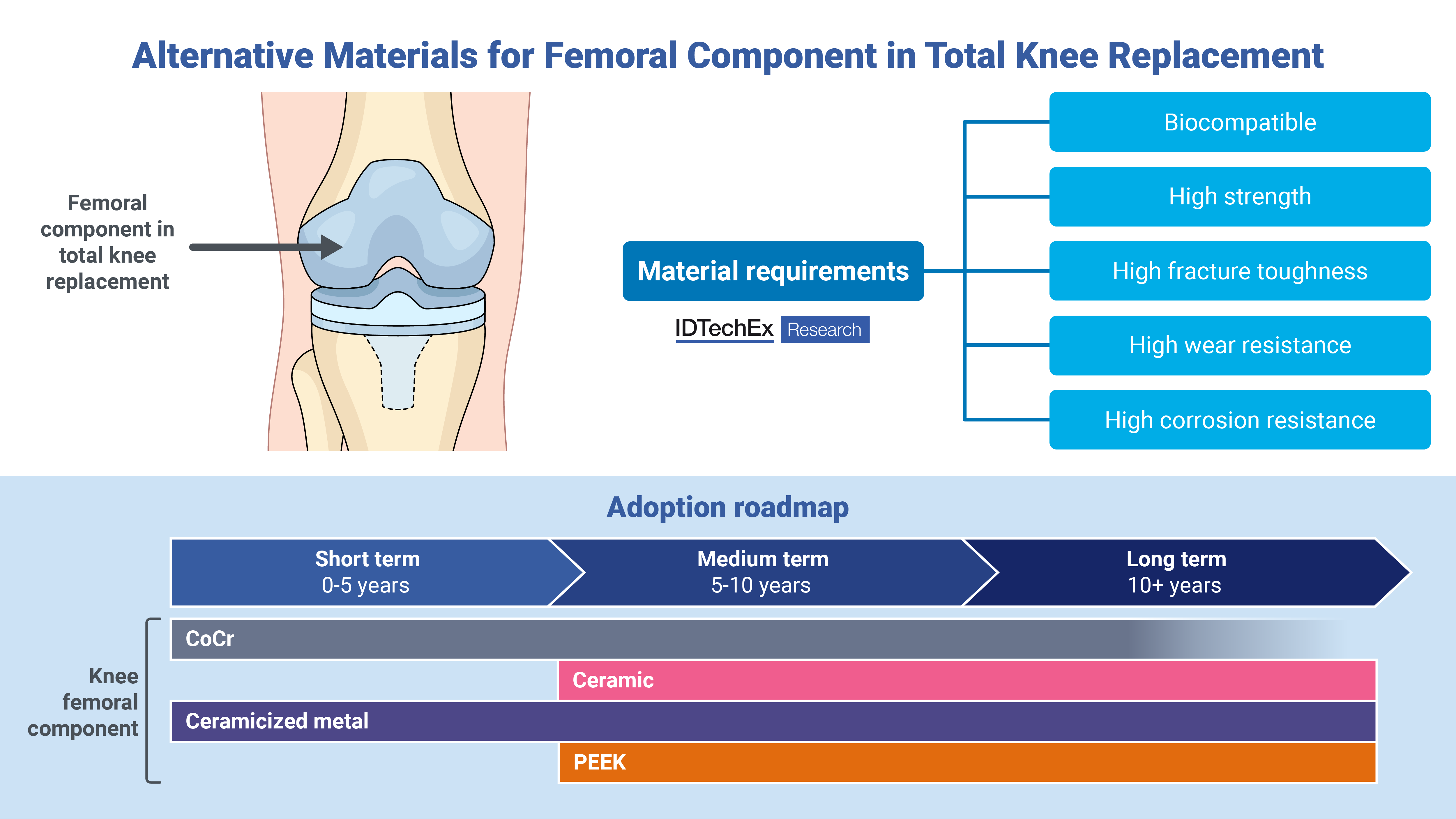
Overview of alternative materials for femoral component in total knee replacement and adoption roadmap. Source: IDTechEx.
Ceramics
Ceramics is the most established alternative, particularly in hip femoral heads, where loading is less aggressive than in the knee. Biolox delta zirconia toughened alumina is the current gold standard. With its original patent now expired, new entrants have flooded into the hip femoral head space. However, knee applications tell a different story. Competing ceramics generally can't match Biolox delta's hardness and fracture toughness, even where in vitro wear rates look comparable. As a result, Biolox delta remains the only ceramic used in knee femoral components today, and the segment remains largely the domain of specialist contract manufacturers.
Ceramicized metals
Ceramicized metals attempt to combine the wear and corrosion resistance of a ceramic with the strength and ductility of a metal. Metals typically undergo surface treatment which gives them localized ceramic-like properties without the fracture risk. Surface-hardened Ti-6Al-4V and oxidized zirconium are the leading candidates for knee femoral components, but adoption has been constrained by patent protection and significantly higher production costs.
Ceramic coatings
Ceramic coatings, predominantly titanium nitride (TiN), offer a different route by depositing a hard, wear-resistant ceramic layer over a tough metallic substrate to block metal ion release without sacrificing the underlying metal's ductility. Coatings achieve higher surface hardness than ceramicized metals thanks to greater ceramic purity, but they can be at risk of delamination from the substrate over time. Currently a niche offering from mostly non-leading players, coated implants targeting metal-sensitive patients are gradually moving toward the mainstream.
PEEK
Polyetheretherketone (PEEK), a polymer already well established in spinal implants, is now being trialed in knee femoral components and is expected to reach commercialization soon. PEEK's stiffness closely matches cortical bone, which may reduce the stress shielding that causes bone resorption and implant loosening around stiffer metal implants. It's also radiolucent, giving surgeons better X-ray visualization of the bone-implant interface. As a thermoplastic, it can be 3D printed or extrusion molded into patient-specific or porous geometries. The key limitation is the lower wear resistance compared to CoCr and ceramics.
Outlook
None of these materials is likely to replace CoCr overnight. Surgeons make implant decisions conservatively, leaning heavily on long-term registry data. CoCr has decades of data behind it, while ceramics, ceramic coatings, ceramicized metals, and PEEK are still building their clinical track records, particularly in the more demanding knee application. This is the real bottleneck: the emerging materials haven't yet accumulated the years of real-world outcome data surgeons rely on to trust a new option over the established one.
That said, the direction of market adoption is clear. The combination of improved patient outcomes and a maturing evidence base should steadily erode CoCr's default status. The IDTechEx report offers quantitative benchmarking of the emerging materials, identifies which segments are likely to see this shift first, and pinpoints which companies are best positioned in each material category.
For more details on hip and knee replacement implants, material trends, and market forecasts, see the IDTechEx market report "Materials for Bone Implants 2026-2036: Trends, Players, and Forecasts". For more information on IDTechEx's other reports and market intelligence offerings, please visit www.IDTechEx.com/Research.
IDTechEx guides your strategic business decisions through its Research, Subscription and Consultancy products, helping you profit from emerging technologies. For more information, contact research@IDTechEx.com or visit www.IDTechEx.com.
